
Novacoat Industrial Coatings GmbH (hereinafter "Novacoat")is an industrial coatings manufacturer specializing in coating applications for construction machinery, automotive parts, and outdoor metal structural parts. In 2024, Novacoat launched the development of a new low-VOC two-component (2K) polyurethane coating and put forward three core requirements to Luxi Chemical: first, to further reduce VOC while maintaining film hardness and weather resistance; second, to lower the coating's application viscosity and improve spray efficiency; and third, to maintain good levelling, adhesion, and film appearance.
Novacoat's R&D team initially adopted a conventional polyisocyanate curing agent. During actual testing, they encountered a thorny problem: the curing agent itself had relatively high viscosity, making the overall formulation system too viscous to meet spray application requirements. To lower the application viscosity, the team was forced to add a certain proportion of solvent — which, while temporarily solving the viscosity issue, caused a significant rise in system VOC. The team thus fell into a classic formulation dilemma: lowering viscosity requires adding solvent, and adding solvent pushes VOC back up. What they needed was a material that could solve the viscosity problem "from the curing agent itself," rather than being "forcibly" thinned by a diluent.
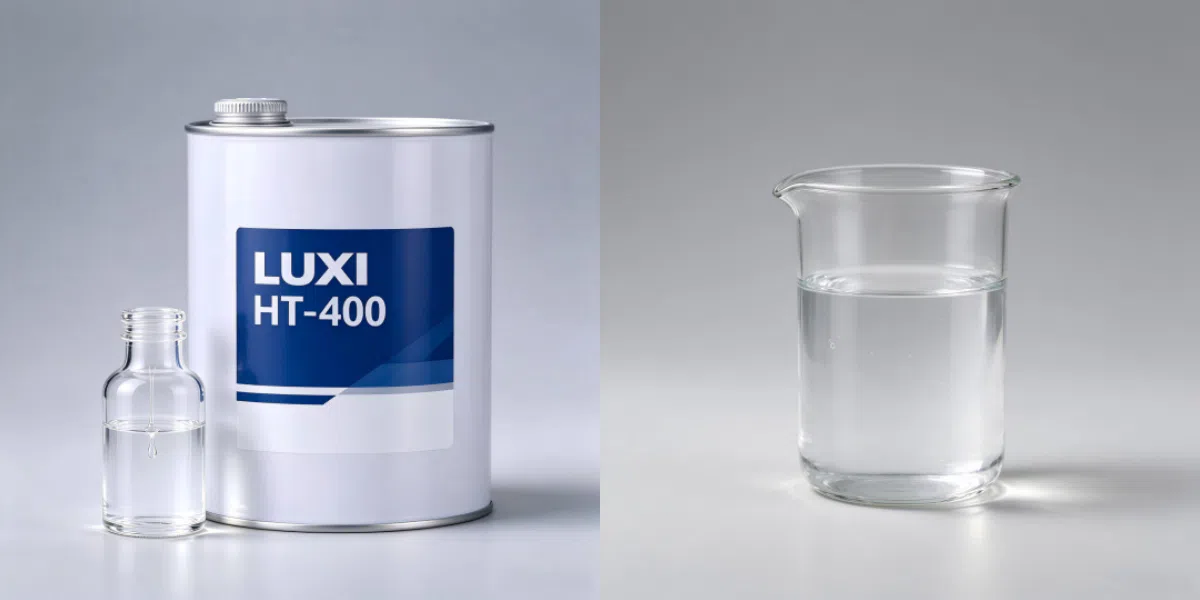
To address this pain point, Luxi Chemical recommended its self-developed low-viscosity polyisocyanate curing agent, LUXI HT-400, to Novacoat. HT-400 features two key characteristics that precisely match the customer's core challenge: ultra-low viscosity — at 25°C its viscosity is only 100–280 mPa·s, far lower than conventional high-viscosity curing agents, leaving formulation engineers greater room for adjustment; and a low-polymerization-degree uretdione structure — which achieves low viscosity at the molecular level rather than relying on inert diluents, thereby preserving the functionality of reactive groups without sacrificing formulation purity.
Based on this, Novacoat's team partially replaced the conventional curing agent with HT-400 and, with Luxi's technical support, carried out three-stage application validation.
Validation 1: Improving Application Viscosity
In the first round, without adjusting other formulation parameters, the focus was on observing changes in system application viscosity. Results showed that after adding HT-400, the system's application viscosity dropped significantly, and the customer's spray-efficiency problem was initially resolved.
Validation 2: Reducing VOC
On the basis of the viscosity improvement, the team gradually reduced the solvent dosage in the system while tracking whether application performance was maintained. After several rounds of formulation adjustment, it was found that, thanks to the formulation headroom created by HT-400's low viscosity, the system's reliance on additional solvent decreased significantly while still meeting the target application performance. In a simulated project test, the final formulation's VOC decreased by approximately 18% compared with the original formulation.
This means that HT-400 did more than just solve the "curing agent viscosity" problem — it transformed "viscosity" and "VOC" from a pair of conflicting constraints into two objectives that could be optimized simultaneously, changing the entire optimization space of the formulation.

Validation 3: Confirming Film Performance
The team then verified whether film performance was compromised after the viscosity and VOC reductions, focusing on film appearance, adhesion, flexibility, and weather resistance. During testing, HT-400 demonstrated two additional advantages: its linear molecular structure helps impart flexibility and elasticity to the film, while its aliphatic structure provides good weather resistance.
Through the three-stage validation, it was ultimately confirmed that HT-400 does not simply "thin" the formulation — it lowers system viscosity while still contributing to the construction of final film performance. In the end, the system's VOC was reduced by approximately 18% while film hardness, weather resistance, adhesion, and appearance were all maintained, and spray application performance was improved, successfully delivering a new product that meets customer requirements.
For Luxi, this cooperation further validated HT-400's value as a core formulation material — by solving the problem "from the curing agent itself," it simultaneously broke through the two major formulation bottlenecks of viscosity and VOC, offering industrial coatings manufacturers a directly applicable solution for product upgrades in the low-VOC direction.


