Ethyl Formate CAS 109-94-4 Products Description
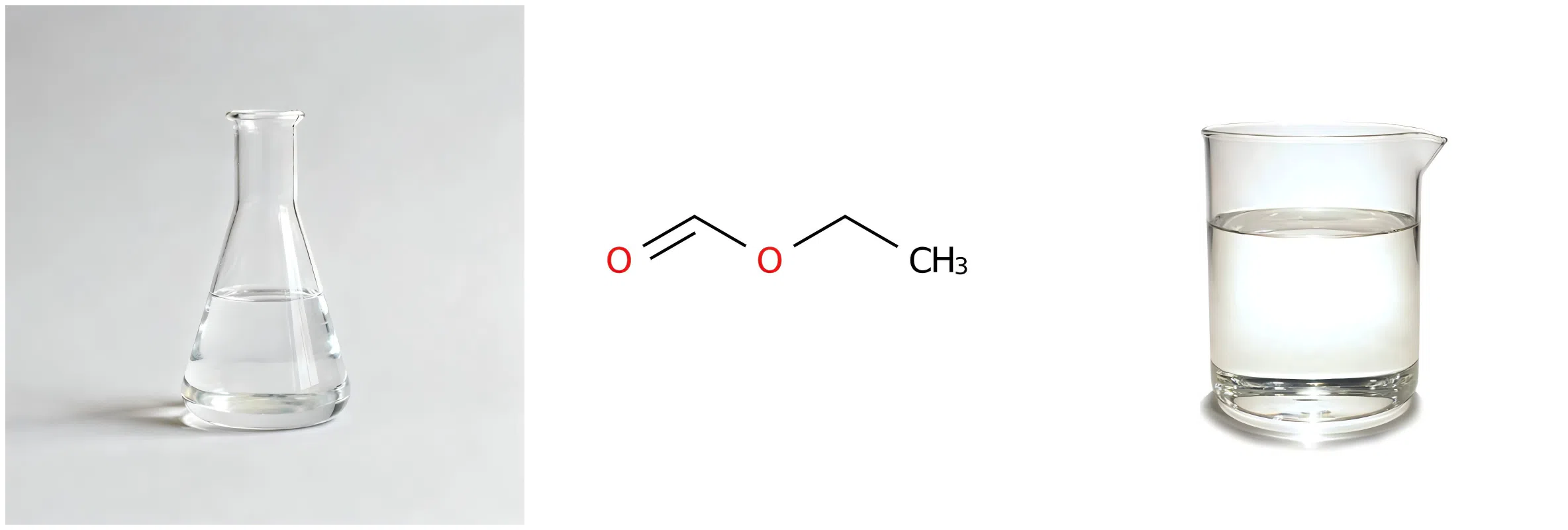
Ethyl Formate is a colorless, low-viscosity liquid widely used as a flavoring ingredient and chemical intermediate. It is approved for use as a food flavoring under GB 2760-96 and is commonly incorporated into flavor formulations for rum, apricot, peach, pineapple, mixed-fruit, and sherry profiles.
Ethyl Formate occurs naturally in a variety of fruits, beverages, and other natural products, including honey, brandy, strawberries, raspberries, onions, apples, pears, rum, Florida orange juice, and Boronia dentigeroides. Its natural occurrence contributes to the characteristic aroma and flavor of many food and beverage products.
On an industrial scale, Ethyl Formate is typically manufactured through the esterification of ethanol with formic acid in the presence of sulfuric acid. The resulting product is then subjected to dehydration and distillation, commonly using phosphorus pentoxide or anhydrous calcium chloride, to obtain the desired purity and quality.
Chemical Properties
| Melting point | -80 °C (lit.) |
| Boiling point | 52-54 °C (lit.) |
| density | 0.921 g/mL at 20 °C (lit.) |
| vapor density | 2.5 (vs air) |
| vapor pressure | 15.16 psi ( 55 °C) |
| refractive index | n20/D 1.359(lit.) |
| FEMA | 2434 | ETHYL FORMATE |
| Fp | 7 °F |
| storage temp. | 2-8°C |
| solubility | Miscible with alcohol, benzene, and ether (Hawley, 1981) |
| form | Liquid |
| color | Clear |
| Odor | Characteristic; pleasant aromatic. |
| Odor Threshold | 2.7ppm |
| Odor Type | ethereal |
| biological source | synthetic |
| explosive limit | 0.16 |
| Water Solubility | 11 g/100 mL (18 ºC) |
| Thermal Conductivity | 0.16 W/(m·K) at 25 ℃ |
| Sensitive | Moisture Sensitive |
| JECFA Number | 26 |
| Merck | 143807 |
| BRN | 906769 |
| Henry's Law Constant | 0.097(x 10-3 atmm3/mol) at 5.00 °C, 0.13 at 10.00 °C, 0.17 at 15.00 °C, 0.23 at 20.00 °C, 0.29 at 25.00 °C (column stripping-UV, Kutsuna et al., 2005) |
| Dielectric constant | 8.4(6℃) |
| Exposure limits | TLV-TWA 100 ppm (~300 mg/m3) (ACGIH, MSHA, and OSHA); IDLH 8000 ppm (NIOSH). |
| Stability: | Stable. Extremely flammable. May form explosive mixtures with air. Note low flash point and wide explosive limits. Incompatible with strong oxidizing agents, strong bases, strong acids, nitrates. |
| Major Application | agriculture |
| cleaning products | |
| cosmetics | |
| environmental | |
| flavors and fragrances | |
| food and beverages | |
| personal care | |
| Cosmetics Ingredients Functions | PERFUMING |
| InChI | 1S/C3H6O2/c1-2-5-3-4/h3H,2H2,1H3 |
| InChIKey | WBJINCZRORDGAQ-UHFFFAOYSA-N |
| SMILES | CCOC=O |
| LogP | 1.504 at 25℃ |
| CAS DataBase Reference | 109-94-4(CAS DataBase Reference) |
| NIST Chemistry Reference | Formic acid, ethyl ester(109-94-4) |
| EPA Substance Registry System | Ethyl formate (109-94-4) |
Safety Information
| Hazard Codes | F,Xn |
| Risk Statements | 11-20/22-36/37 |
| Safety Statements | 9-16-24-26-33 |
| OEB | A |
| OEL | TWA: 100 ppm (300 mg/m3) |
| RIDADR | UN 1190 |
| WGK Germany | 1 |
| RTECS | LQ8400000 |
| Autoignition Temperature | 851 °F |
| TSCA | TSCA listed |
| HazardClass | 3 |
| PackingGroup | II |
| HS Code | 29151300 |
| Storage Class | 3 - Flammable liquids |
| Hazard Classifications | Acute Tox. 4 Inhalation |
| Acute Tox. 4 Oral | |
| Eye Irrit. 2 | |
| Flam. Liq. 2 | |
| STOT SE 3 | |
| Hazardous Substances Data | 109-94-4(Hazardous Substances Data) |
| Toxicity | LD50 orally in rats: 4.29 g/kg (Smyth) |
| IDLA | 1,500 ppm |
Product Application of CAS#109-94-4
Ethyl Formate is widely utilized as an effective solvent for nitrocellulose and cellulose acetate, making it useful in various industrial and chemical processing applications. In the pharmaceutical and fine chemical industries, it also serves as a valuable synthetic intermediate in the preparation of pyrimidine compounds such as uracil, cytosine, and thymine, supporting the production of various pharmaceutical and biochemical products.