
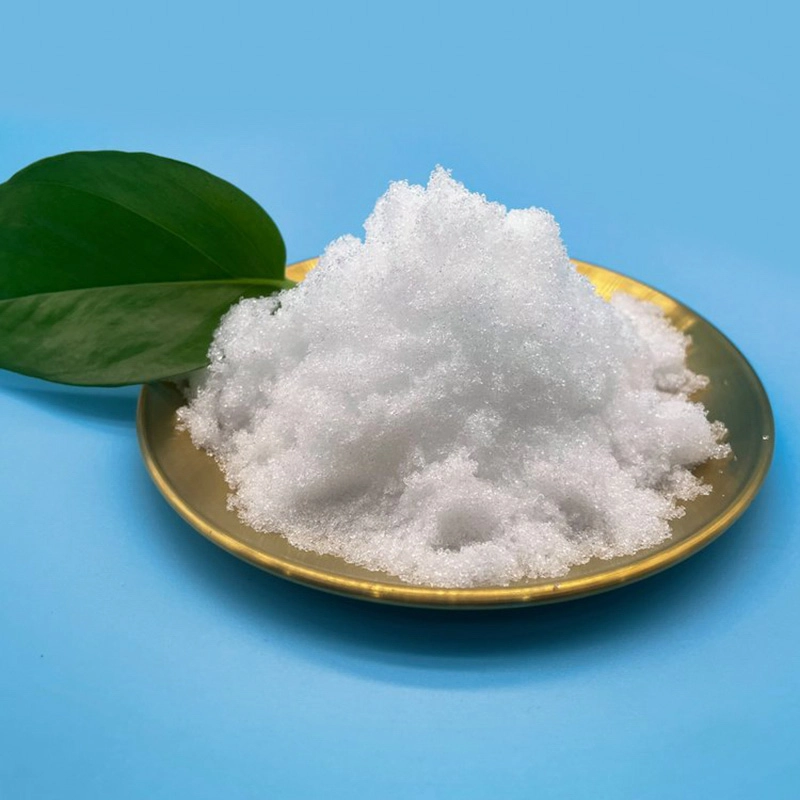
Sodium Acetate CAS#127-09-3
Sodium acetate (CH₃COONa) is the sodium salt derived from acetic acid. It is generally found as a colorless, crystalline, hygroscopic solid and is valued for its versatile chemical properties across industrial, laboratory, and commercial applications.
In textile processing, sodium acetate can be used to neutralize acidic wastewater containing sulfuric acid and may also function as a photoresist in certain dyeing processes. In the construction industry, it can be applied as a concrete sealing material to help improve resistance to moisture-related deterioration. In food processing, sodium acetate is commonly used as a seasoning and acidity-regulating agent.
Sodium acetate is also widely employed as a buffering agent in laboratory and chemical applications. Its ability to undergo reversible heat absorption and release makes it a key material in reusable heating pads, hand warmers, and hot-ice products.
For laboratory-scale preparation, sodium acetate can be obtained by neutralizing acetic acid with sodium carbonate, sodium bicarbonate, or sodium hydroxide. On an industrial scale, it is commonly produced through the neutralization of glacial acetic acid with sodium hydroxide, followed by appropriate concentration and crystallization processes.
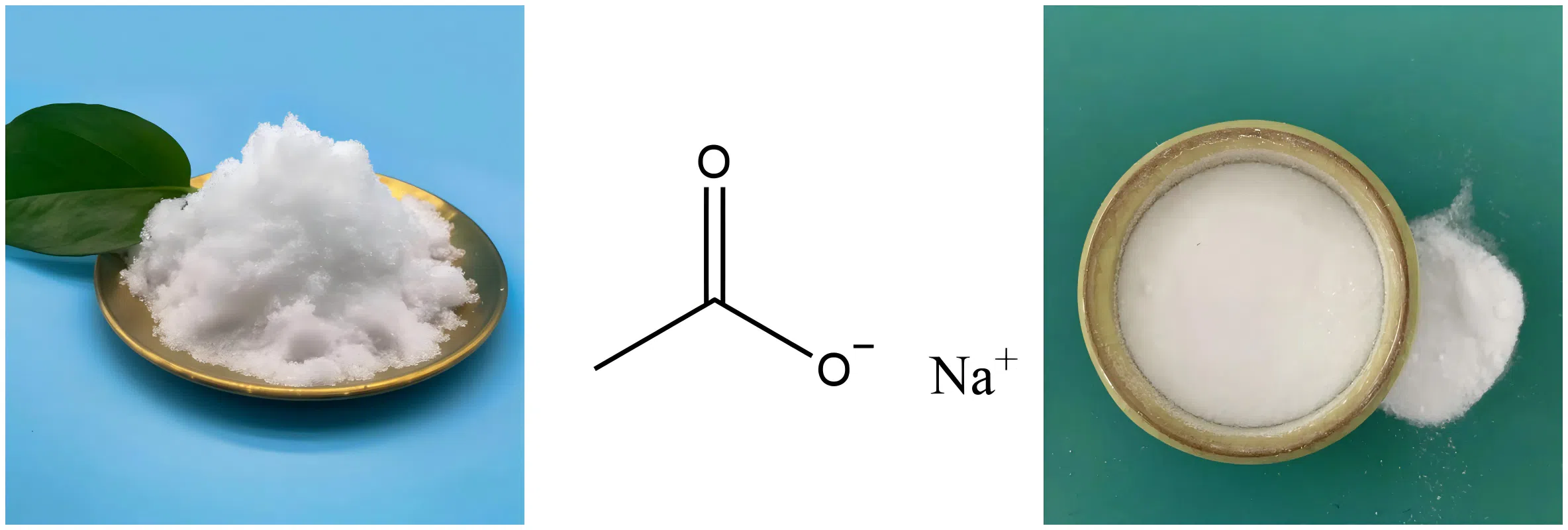
Sodium acetate Chemical Properties
| Melting point | >300 °C (dec.)(lit.) |
| density | 1.01 g/mL at 20 °C |
| FEMA | 3024 | SODIUM ACETATE |
| refractive index | 1.464 |
| Fp | >250 °C |
| storage temp. | Store at +5°C to +30°C. |
| solubility | H2O: 3 M at 20 °C, clear, colorless |
| pka | 4.756[at 20 ℃] |
| form | powder |
| color | white |
| Specific Gravity | 1.45 |
| Odor | Slight acetic acid |
| PH | 7.87(1 mM solution);8.33(10 mM solution);8.75(100 mM solution);9.04(1000 mM solution) |
| PH Range | 8.5 - 9.9 at 246 g/l at 25 °C |
| Odor Type | odorless |
| biological source | synthetic |
| Water Solubility | 500 g/L (20 ºC) |
| λmax | λ: 260 nm Amax: 0.03 |
| λ: 280 nm Amax: 0.02 | |
| Sensitive | Hygroscopic |
| Hydrolytic Sensitivity | 0: forms stable aqueous solutions |
| Merck | 148571 |
| Boiling point | >400°C(decomposition) |
| BRN | 3595639 |
| Stability: | Stable. Incompatible with strong oxidizing agents, halogens. Moisture sensitive. |
| Cosmetics Ingredients Functions | BUFFERING |
| FRAGRANCE | |
| InChI | 1S/C2H4O2.Na/c1-2(3)4;/h1H3,(H,3,4);/q;+1/p-1 |
| InChIKey | VMHLLURERBWHNL-UHFFFAOYSA-M |
| SMILES | [Na+].CC([O-])=O |
| LogP | -3.72 |
| CAS DataBase Reference | 127-09-3(CAS DataBase Reference) |
| NIST Chemistry Reference | Sodium ethanoate(127-09-3) |
| EPA Substance Registry System | Sodium acetate (127-09-3) |
| Absorption | ≤0.01 at 260nm in H2O at 100mM |
| ≤0.01 at 280nm in H2O at 100mM |
Safety Information
| Safety Statements | 22-24/25 |
| WGK Germany | 1 |
| RTECS | AJ4300010 |
| F | 3 |
| Autoignition Temperature | 607 °C |
| TSCA | TSCA listed |
| HS Code | 29152200 |
| Storage Class | 11 - Combustible Solids |
| Hazardous Substances Data | 127-09-3(Hazardous Substances Data) |
| Toxicity | LD50 orally in Rabbit: 3530 mg/kg LD50 dermal Rabbit > 10000 mg/kg |

Product Application of Sodium Acetate CAS#127-09-3
Sodium acetate is a versatile chemical with applications across a variety of industrial, laboratory, and food-related fields. It is commonly used as a mordant in textile dyeing and also finds use in photographic processing, glucose purification, meat preservation, leather tanning, and dehydration processes. In analytical and laboratory chemistry, sodium acetate is widely employed to prepare buffer solutions and maintain stable pH conditions.
Within the food industry, sodium acetate serves as a preservative for processed meat and other food products. It may be used in combination with acid-based preservatives such as lactates and propionates to provide enhanced preservation and microbial control. Typical application levels are generally around 0.2%–0.5%, depending on the specific product and applicable regulations. Sodium acetate is also commonly incorporated into salad dressings, ready-to-eat foods, and other processed food formulations.