
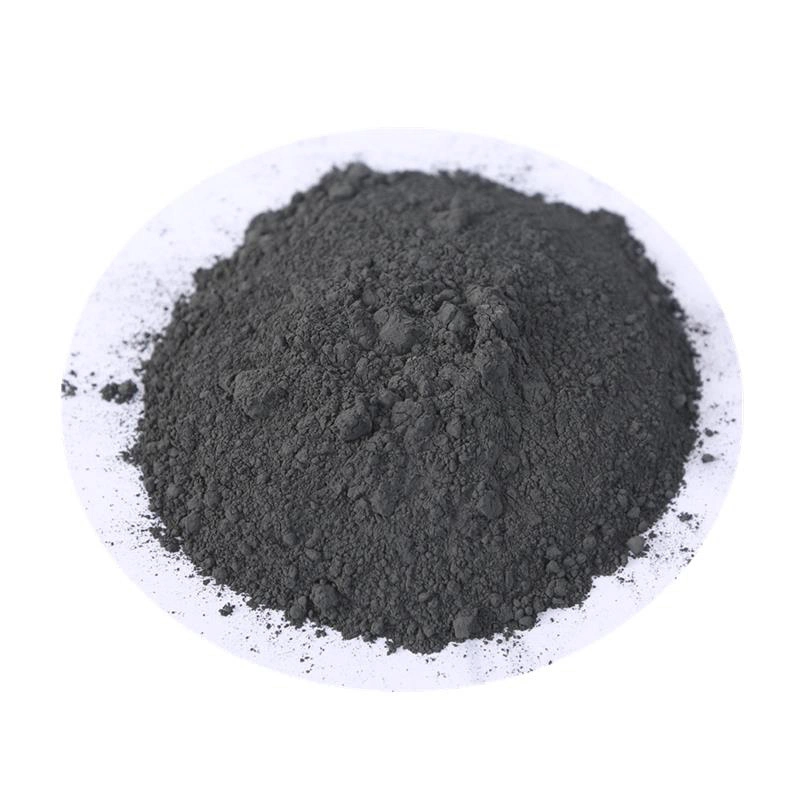
Products Description of Triiron Tetraoxide CAS #1317-61-9
Triiron Tetraoxide (Fe3O4, CAS# 1317-61-9)—commonly known as Magnetite or Black Iron Oxide—is a versatile inorganic compound. In addition to direct extraction from natural magnetite ores, it is manufactured via three primary synthetic routes:
Chemical Co-Precipitation: Prepared by reacting a 1:2 molar ratio of ferrous (Fe2+) and ferric (Fe3+) salts with a base such as sodium hydroxide, yielding an intermediate hydroxide that dehydrates upon heating to form Fe3O4:
Fe(aq)2++2Fe(aq)3++8OH(aq)−→Fe3(OH)8(s)
Fe3(OH)8(s)ΔFe3O4(s)+4H2O(g)
Controlled Partial Oxidation: Produced by the thermal oxidation of elemental iron or iron(II) sulfate under restricted oxygen supply.
High-Temperature Steam Reaction: Synthesized through the direct reduction of water vapor by iron at elevated temperatures:
3Fe+4H2O→Fe3O4+4H2
These adaptable synthesis pathways allow precise control over particle size, magnetic susceptibility, and color intensity.
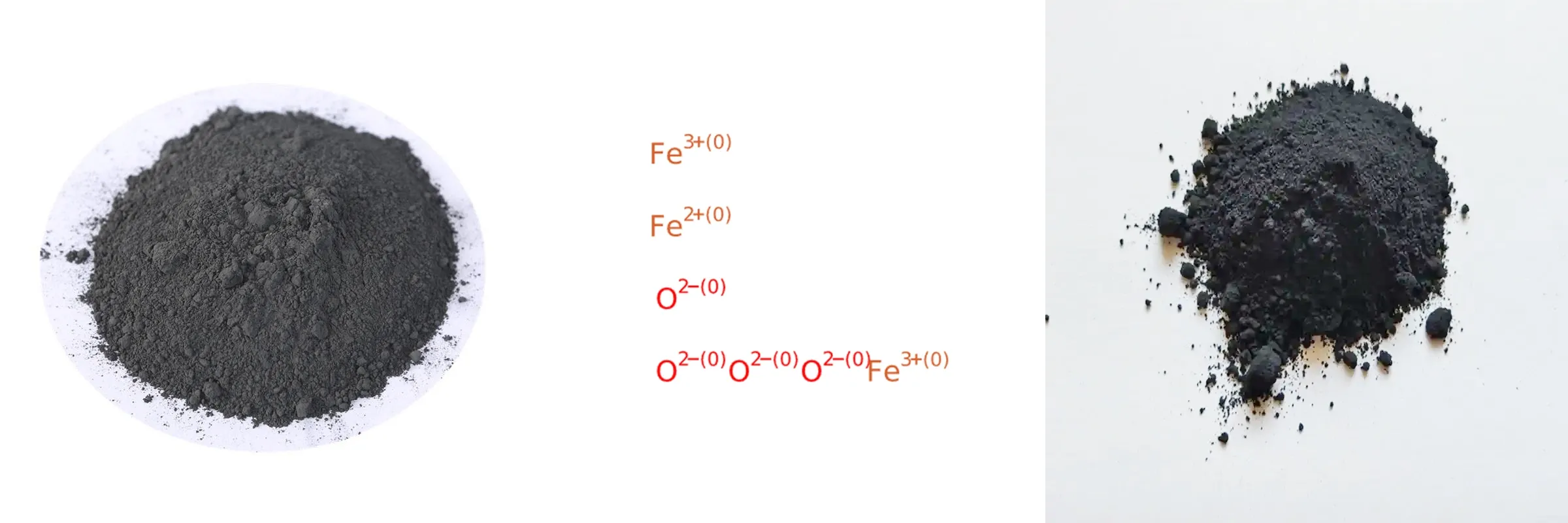
Triiron tetraoxide Chemical Properties
| Melting point | 1538 °C(lit.) |
| density | 4.8-5.1 g/mL at 25 °C(lit.) |
| refractive index | 3 |
| Fp | 7 °C |
| storage temp. | -20°C |
| solubility | Aqueous Acid (Slightly) |
| form | powder |
| color | black |
| Specific Gravity | 5.2 |
| Odor | at 100.00?%. odorless |
| Water Solubility | Insoluble in water and organic solvents. Soluble in concentrated mineral acids. |
| Crystal Structure | Inverse spinel type |
| crystal system | Cube |
| Merck | 144040 |
| Space group | Fd3m |
| Lattice constant | a/nmb/nmc/nmα/oβ/oγ/oV/nm30.839410.839410.839419090900.5915 |
| Stability: | Stable. Incompatible with strong acids, chloroformates, peroxides. |
| CAS DataBase Reference | 1317-61-9(CAS DataBase Reference) |
| NIST Chemistry Reference | Iron(ii,iii) oxide(1317-61-9) |
| EPA Substance Registry System | Iron oxide (Fe3O4) (1317-61-9) |

Product Application of Triiron Tetraoxide CAS #1317-61-9
Leveraging its deep black hue, strong magnetism, and catalytic activity, Triiron Tetraoxide serves diverse high-tech and industrial sectors:
Pigments & Coloration: Serves as a primary black inorganic pigment in construction materials, polymers, rubber compounds, cosmetics, polishing pastes, and high-performance magnetic inks.
Catalysis & Industrial Processing: Acts as a key catalyst in chemical processes, including the Haber-Bosch ammonia synthesis and water-gas shift reactions.
Medical & Diagnostics: Utilized as a specialized T2 contrast agent in Magnetic Resonance Imaging (MRI) and biomedical research.
Electronics & Functional Fillers: Integrated into magnetic recording materials, electronic appliances, anti-static products, and structural fillers.